Updated 26 January, 2007
Summary
1. Population projections are produced regularly by the Government Actuary’s Department (GAD). They have to make assumptions about international migration which they base on recent trends.
2. The international migration assumption has been steadily increased over the last decade but it has consistently underestimated the increase in net international migration to the UK.
3. The latest projections are based on an assumption of 145,000 a year. They show that immigration at that level will contribute nearly 6 million (83%) to the projected rise in the UK’s population of 7.2 million between 2004 and 2031 or about 200,000 people each year.
4. Population projections are an important input to the planning process – particularly in relation to house building plans. The underestimation of the levels of migration is likely to have contributed to shortfalls in the house building programme.
Detail
5. Some components of demographic growth, such as birth and mortality rates change only slowly over time but international migration fluctuates considerably and is the most difficult to forecast. This is because international migration flows vary according to the economic, political and legal situation both in the countries of origin and in the country of destination. Nonetheless a migration assumption has to be made because it is an increasingly important component of national population and household projections required for planning purposes.
6. Most official projections in the UK and elsewhere are based on a continuation of recent trends. It is assumed that these trends of inflow and outflow will continue, on a curve based on statistical analysis of the data. In official UK projections the trends are moderated so that emigration and immigration do not decline or increase indefinitely at the same rate, but instead level off gradually.
7. Until the mid-1990s all official UK migration projections assumed that this levelling off would mean that net migration would decline to zero after some years. In the 1991-based projections
[1], for example, the then current net inflow of 50,000 was assumed to increase to 65,000 by 1993-4 and then decline to zero by 2015. This assumption was, of course, in line with the declared UK government policy (until 1997) to minimise the level of migration for permanent settlement.
8. This assumption has now been abandoned in the light of continued increases in the level of migration. The projection of net immigration has been increased (through several stages). The latest projections, produced by the Government Actuary’s Department (GAD) in 2005 (based on the estimated population of the UK in mid-2004), use, in their principal population projections, net international migration levels of 255,000 in 2004-5 reducing rapidly to 145,000 in 2007-8 and staying constant at 145,000 each year thereafter. Over the last few years the levels of net international migration used by GAD in their projections have consistently lagged behind the actual levels of international migration as the following graph demonstrates:
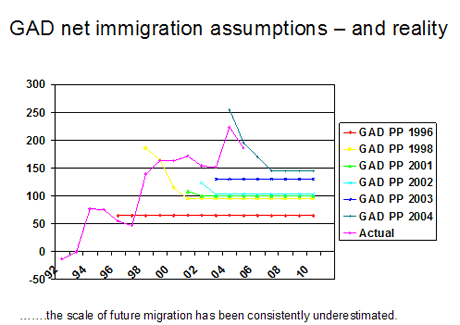
(Note: the population projection years refer to the year from which the population is projected. The projections are normally produced and published a year after this. The Y axis scale is the level of net international migration in thousands).)
9. Of course it remains to be seen whether future levels of net international migration will be close to GAD’s latest projections – much will depend on political decisions such as whether the European Union will continue to expand to embrace countries such as Turkey.
10. GAD produce a number of ‘variant’ projections as well as the principal projections. These include high and low migration variants (which assume long-term annual migration rates of 205,000 and 85,000 respectively) and a ‘natural change’ variant which shows the projected population if there were no migration either into the UK or from the UK. This is, of course, not a realistic scenario but its value is in showing the impact of immigration on future population. The following graph shows the projections of the UK population (in millions) based on the principal immigration assumption of 145,000 a year, the high migration variant (205,000 a year), a continuation of the 1998-2004 average levels of actual net migration (166,000 year) and the ‘natural change only’ variant.
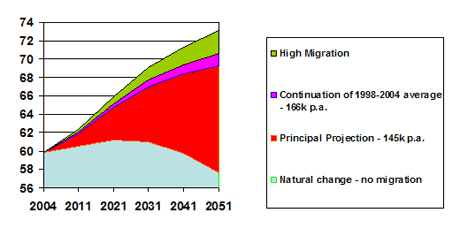
11. As can be seen the population of the UK would increase slowly for a while before gently declining if there were no migration (the light blue area). This compares to the principal population projection, using a net migration assumption of 145,000 a year, which shows the population increasing from its 2004 level of 59.8 million to 67.0 million in 2031 and to 69.2 million in 2051.
12. GAD have compared the principal population projection and the natural change projection between 2004 and 2031. The comparison shows that of the 7.2 million projected increase in the UK’s population shown by the principal projection by 2031, 4.1 million will result from the assumed level of net migration and a further 1.85 million will result from births to this migrant population[2]. In total, migration (migrants and their descendants) will account for nearly 6 million of the 7.2 million increase in population projected between 2004 and 2031. Migration is therefore expected to add about 200,000 to the UK’s population each year or a city the size of Birmingham every 5 years.
13. The population projections are particularly important because they inform planning decisions. One critical area is the household projections which are a major input to the house building plans. Until recently household projections were based on the 1996-based population projections which assumed a net international migration rate of 65,000 per annum. The projections were updated in 2004 to use a migration rate of 130,000 and again in 2006 to use updated assumptions about life expectancy and household formation rates. However, the 2006 household projections still use a migration assumption of 130,000 a year rather than the most recent principal assumption of 145,000.
Footnotes
- Office of Population Censuses and Surveys (1993) National Population Projections 1991-based. Series PP2 no. 18. London. HMSO (now The Stationery Office) pp 14 - 19
- GAD Migration and Population Growth at http://www.gad.gov.uk/Population/2004/methodology/mignote.htm
- Office of Population Censuses and Surveys (1993) National Population Projections 1991-based. Series PP2 no. 18. London. HMSO (now The Stationery Office) pp 14 - 19
- GAD Migration and Population Growth at http://www.gad.gov.uk/Population/2004/methodology/mignote.htm