5 May, 2006
Summary
1. Romania and Bulgaria are due to join the EU on 1 January 2007.
2. Labour market transitional arrangements will be virtually the same as for the first round of East European candidate countries.
3. Their combined population is nearly 30 million and their unemployment rates are 8% (Romania) and 10% (Bulgaria). Bulgaria has 700,000 ethnic Turks and there are 2.5 million Roma in these two countries.
4. If the UK is again the only major EU country not to impose a transitional arrangement, further substantial immigration is to be expected. The statistical evidence suggests that migration for work could be nearly 300,000 in the first 20 months. It would be prudent, therefore, for the government not to open our labour market until the intentions of other EU15 states are clear. It will also be essential to close off the benefit system, as for the earlier round, to prevent benefit tourism.
Detail
5. Romania and Bulgaria are scheduled to accede to the European Union on 1 January 2007. A decision on whether or not to defer accession for a year will be taken by the European Council on 15/16 June 2006. Unless the UK Government imposes a transition period, entry to the EU will give workers from those countries rights of access to the UKs labour market similar to those enjoyed by workers from those countries that acceded on 1 May 2004 (Annex A).
6. The Governments Accession Monitoring Report, published on 28 February 2006, showed that there were 345,000 applicants to the Worker Registration Scheme from the eight central and Eastern European countries (the A8) between 1 May 2004 and 31 December 2005. Of these, up to 60,000 may have already been in the UK before 1 May 2004. 80 per cent were earning less than 6 per hour. 58 per cent, or 170,000, were from Poland. The Governments original estimate, challenged at the time by Migrationwatch, for net immigration from these states was 5-13,000 per year. The Office for National Statistics (ONS) believes that net migration from the accession countries in 2004 was 48,000; the Migrationwatch cautious estimate was 40,000 a year.
7. It is likely that unemployment and low incomes are the major drivers of labour migration from the former Eastern Bloc countries. In Poland, unemployment is currently running at 17.7 per cent and annual GDP per head is around $12,700 compared to 5.1 per cent and $30,900 in the UK. In Romania and Bulgaria, unemployment is lower than in Poland, at 7.7 and 9.9 per cent respectively, but incomes are also distinctly lower, averaging $8,400 and $9,000 respectively. (These comparisons are on a purchasing power parity basis). Romania has a population of 21.7 million and Bulgaria 7.8 million
[1]. It is therefore likely that the accession of Romania and Bulgaria in January 2007 will result in further significant labour migration to the United Kingdom.
8. The decision of the other major EU countries to extend transitional measures for the A8 countries for a further three years makes it virtually certain that similar measures will be applied to Romania and Bulgaria.
IPPR Estimate
9. In April 2006, the IPPR published an estimate which assumed that a similar proportion of Bulgarian and Romanian nationals as A8 nationals would come to the UK. This amounted to 50,000 Romanians and 18,000 Bulgarians in the first year. They further assumed that 18% would already be here, giving new migrants at 41,000 Romanians and 15,000 Bulgarians or 56,000 in total.
10. The estimate also assumed, probably correctly, that other EU labour markets would remain closed to Romanians and Bulgarians for a transitional period. However, while recognising the importance of living standards, it made no allowance for the fact that Romanians and Bulgarians are significantly poorer than the A8. Their GDP per capita is just under 30% of the EU average compared to 45% for A8 countries.
The Impact of Poverty
11. The Department of Work and Pensions have reached the preliminary conclusion that there appears to be a statistical association between the level of GDP per head in the new EU member states and the propensity to enter the UK labour market.
[2]They illustrated this with a figure, reproduced below:
Figure 4.3 Correlation between GDP per head in country of origin and proportion of the population registering on the WRS
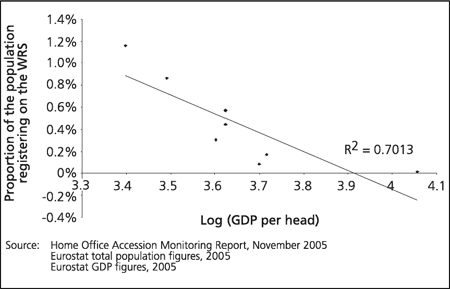
12. Professor Mervyn Stone has applied the same methodology to Bulgaria and Romania and has come up with some startling results
[3]. The governments own methodology suggests that, even on a very conservative interpretation of the data, some 80,000 Bulgarians and 210,000 Romanians would seek work in the UK in a similar 20 month period.
13. The situations are not, of course, exactly parallel; in particular, unemployment rates are much lower than in Poland, the main source of immigrants from the A8, and the UK labour market may not be able to absorb low paid workers on such a scale. However, given these uncertainties and the governments wildly inaccurate forecasts on the last occasion, it would be simple prudence not to open our labour market to these two new members until other EU members start to open theirs.
14. The Bulgarian population includes 700,000 ethnic Turks and the two countries include 2.5 million Roma
[4]. Both communities suffer discrimination. As in the earlier expansion to Eastern Europe, it will be essential to close off immediate access to the UK benefit system by extending the Workers Registration Scheme to workers from these two countries. There is also a risk that citizens of Turkey will enter the EU by claiming to be Bulgarians.
Annex A
Transitional measures applied to the countries that acceded on 1 May 2004:
| |
a two year period during which national measures may be applied by current Member States to Romania and Bulgaria; |
| |
after this period, reviews will be held: one automatic review before the end of the second year after accession and a further review at the request of the acceding country affected. The procedure includes a report by the European Commission, but leaves to current member states the decision on whether to apply the whole body of relevant EU law as it already applies to workers from other Member States; |
|
the transitional arrangement should in principle come to an end after five years, but may be prolonged for a further two years in those current Member States where there would be serious disturbances of the labour market or a threat of such disruption; |
| |
safeguards may be applied by Member States up to the end of the seventh year. |
A standstill clause will apply, whereby current Member States cannot apply more stringent restrictions on their labour markets than those prevailing at the time of the signature of the Accession Treaty (which took place on 25 April 2005). Current Member States must give preference to nationals of Romania and Bulgaria over non-EU labour.
Austria and Germany have the right to apply flanking national measures to address serious disturbances or the threat of such disturbances, in specific sensitive service sectors of their labour markets in certain regions.
Under the transitional arrangements the rights of nationals from Romania and Bulgaria who are already legally resident and employed in a current Member State are protected. The rights of family members are also taken into account consistent with the practice in the case of previous accessions.
A declaration to the Accession Treaty states that current Member States shall endeavour to grant increased labour market access under national law, with a view to speeding up access before accession. This declaration is, however, not legally binding.
Footnotes
| [1] |
Populations and unemployment rates for 2005 from Eurostat, GDP at purchasing power parities from CIA World Fact Book (2005 estimates) |
| [2] |
Working Paper 29 of 2006 |
| [3] |
published on the Civitas web site.http://www.civitas.org.uk/pdf/BulgariaRomania.pdf |
| [4] |
CIA World fact book |